
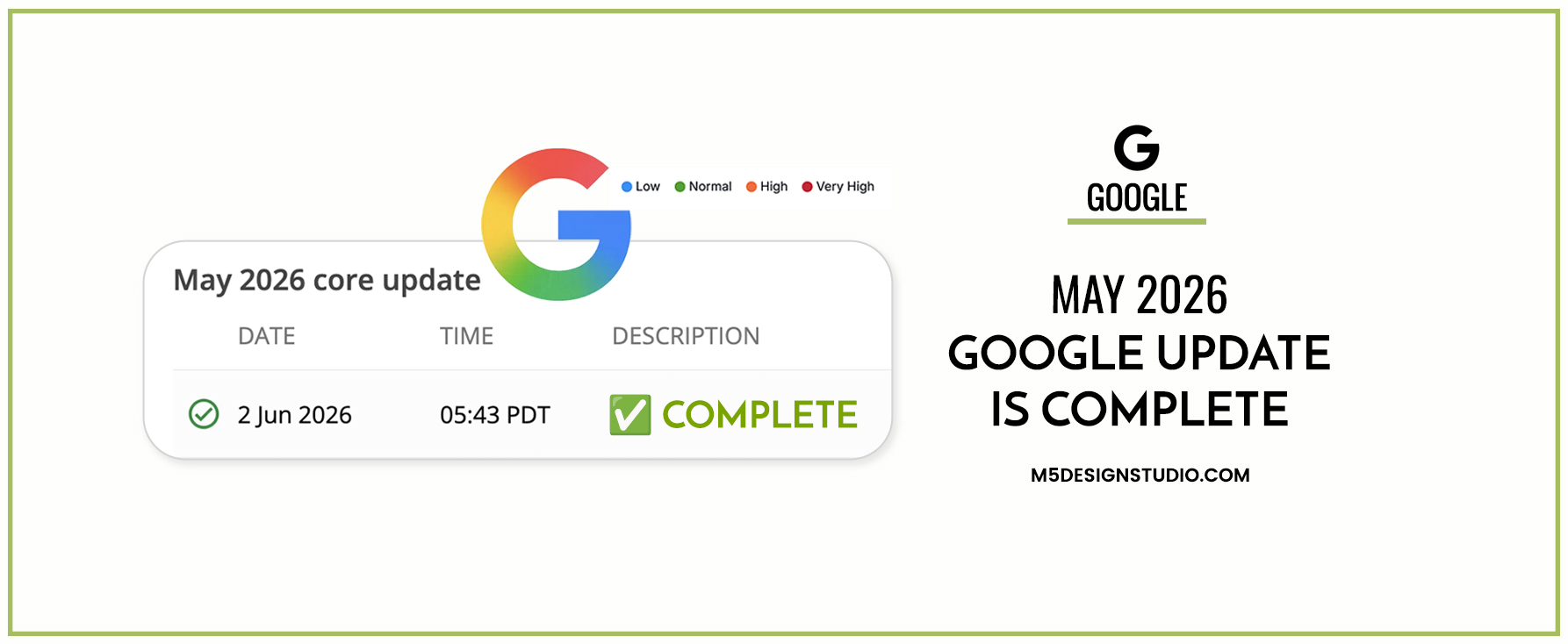
It is official. The May 2026 Google core update completed on June 2, twelve days after it began. If you have been checking back since our original article, this is the follow-up we said was coming.
When we published What the May 2026 Google Core Update Means for Your Website and What to Do Now on May 29, we made two commitments.
First, that M5 was monitoring client accounts in real time. Second, that we would come back with a post-completion analysis once the rollout finished. Now it has. Here is what we know.
This article covers what the completion data shows, why so many sites saw their rankings move twice during the rollout, how volatile this update was compared to March, what the early directional data tells us about winners and losers, and the one timeline correction that most business owners need to hear right now.
The full sector-level winners and losers breakdown is still being compiled. That deeper analysis is coming in our next June article, including what to do if you dropped, what to prioritize if you gained, and what the data shows across different industries.
This article is focused on what we know right now that the rollout is complete. The two-wave pattern is visible. The volatility numbers have context. And there is one timeline correction every business owner needs to make today: the clean data window starts after the rollout ends, not when it begins.
May 2026 Google Core Update: What We Now Know
If you have been checking back since our original article, here is the updated picture:
- The May 2026 core update was completed on June 2, 2026, twelve days after launching on May 21, finishing slightly ahead of Google’s predicted two-week window.
- This was one of the most volatile core updates in recent years. SEMrush Sensor recorded peak volatility of 7.0 out of 10 during the rollout, classified as High, with multiple spikes across the twelve-day period. As of June 3, volatility has returned to 0.9 out of 10, confirming the update has settled
- SEMrush Sensor data shows multiple High volatility spikes across the twelve-day rollout rather than a single peak event. Rankings moved, settled briefly, then moved again. If that is what your dashboard looked like over the past two weeks, you were not alone and you were not dealing with two separate problems.
- The one-week wait M5 recommended in the original article starts from June 2, not May 21. Begin your full Search Console assessment around June 9.
- Early third-party tracking data suggests a directional pattern consistent with March 2026: brands, institutions, and original sources appear to have gained visibility, while aggregators, generic content sites, and sites with unedited AI-generated content appear to have lost ground.
- The GSC Links report bug that began on May 21 remains unresolved as of June 3, 2026. The report is currently showing placeholder data from before the bug occurred, not your current live link profile. Use Ahrefs or SEMrush to verify your actual backlink data.
- The impression logging error that ran from May 2025 through April 2026 has been resolved. Search Console impression data from April 27, 2026 onward is accurate.
- Full sector-level winners and losers analysis is still being compiled. The full sector-level analysis is coming in M5’s follow-up post, publishing soon.
May 2026 Google Core Update: Final Status Overview
| Update name | May 2026 Core Update |
| Rollout started | May 21, 2026 |
| Rollout completed | June 2, 2026 |
| Duration | 12 days |
| Volatility scores | SEMrush Sensor peak: 7.0/10 (High). Current reading June 3: 0.9/10 (Low). Multiple High spikes confirmed during rollout. |
| Rollout pattern | Multiple High volatility spikes across the rollout per SEMrush Sensor data. Rankings moved, settled, then moved again. |
| GSC Links report bug | Still unresolved as of June 3, 2026. Showing placeholder data. Use Ahrefs or Semrush as directional third-party checks. |
| Impression logging bug | Resolved. Data from April 27, 2026, onward is accurate. Historical data will not be corrected. |
| Assessment start date | June 9, 2026, one week after completion |
It Is Official: The May 2026 Core Update Is Complete
The May 2026 Google core update completed on June 2, 2026, twelve days after it began on May 21. Google confirmed the completion via the Google Search Status Dashboard, finishing slightly ahead of the two-week window Google had initially projected.
This is the second broad core update of 2026. The first, the March 2026 core update, ran from March 27 to April 8, twelve days as well. If you want the full background on what core updates are, why they happen, and what they mean for your business, that is covered in detail in our original article. What the May 2026 Google Core Update Means for Your Website and What to Do Now.
What this article picks up where that one left off: now that the dust has settled, what did the data show, and what do you do next.
Why Your Rankings Moved More Than Once During the Rollout
If your rankings dropped, stabilized briefly, then dropped again around May 30, you were not imagining it, and you did not have two separate problems.
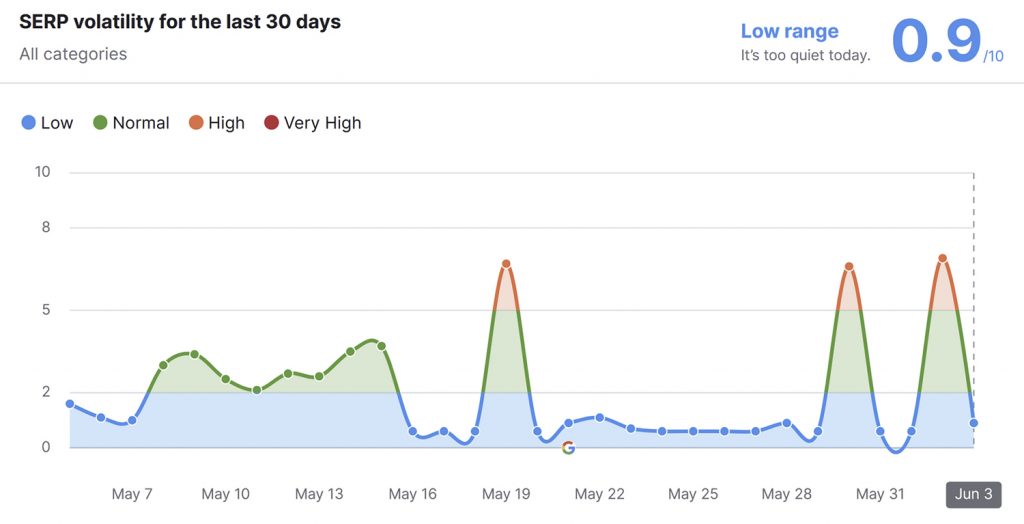
SEMrush Sensor data shows the May 2026 core update did not move rankings in one clean wave. The chart recorded multiple High volatility spikes across the twelve-day rollout, with peaks around May 19, May 30, and June 1 to 2, separated by brief periods of relative calm. Rankings moved, appeared to stabilize, then moved again.
That matters for diagnosis.
If your site moved early, then shifted again later, that does not automatically mean two separate problems hit you. It may simply reflect how the update rolled through different parts of Google’s systems over time.
This is why mid-rollout analysis can get messy fast. A site can look like it stabilized, then move again when the next cluster hits.
This is not unusual for a core update of this scale, though Google does not explain it in real time to site owners. Here is the context that Google does not volunteer.
Google has already said rankings can move around during a core update rollout.
That is important, and here is an example of normal fluctuation for one keyword we track:
- May 1st: Position 1
- May 12th: Position 2
- May 15th: Position 1
- May 16th: Position 2
- May 20th: Position 1
- June 4th: Position 1
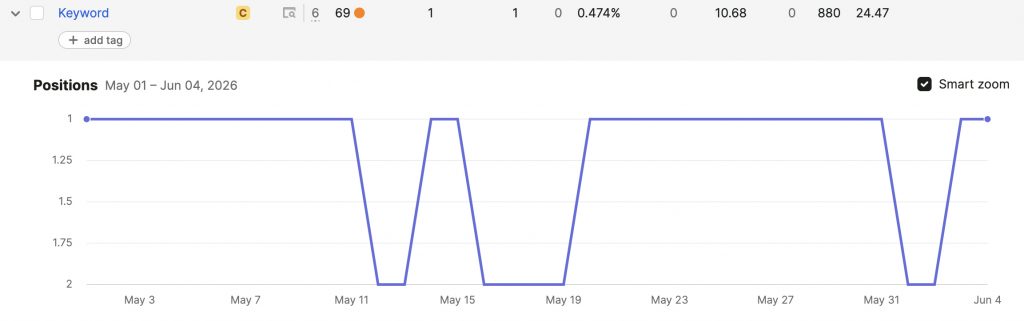
Short-term movement does not always show where a site will land once the update is finished. Per Google’s own core update documentation, rankings can fluctuate during a rollout and should not be treated as stable until the update completes. The multiple volatility spikes SEMrush Sensor recorded across the twelve-day period are consistent with exactly that kind of in-progress turbulence.
What Google has not explained is why the movement clustered that way. And, for most businesses, that is not the most useful question anyway.
The practical takeaway is simpler: if your site moved once, then moved again during the same rollout, do not automatically assume you have two separate problems. You may just be seeing one update play out in stages.
Here is what that means for business owners who watched their rankings move twice in ten days with no explanation from Google: your experience was a normal fluctuation for this specific rollout. The absence of any communication from Google about why it was happening is not normal, but it is consistent. Google does not narrate its own rollouts in real time. You are left watching a dashboard that makes no sense until after the fact, and that is a real operational problem for businesses trying to make decisions with incomplete information.
If your rankings moved twice, document both data points. They belong to the same event. Wait until your June 9 assessment window before drawing conclusions from either.
How Volatile Was This Update? Putting the Numbers in Context
This was not a routine update, regardless of how Google described it.
SEMrush Sensor recorded peak volatility of 7.0 out of 10 during the rollout, classified as High on its scale, with multiple spikes across the twelve-day period. For context, the weeks before the update launched showed Normal range readings between 2 and 3.5, and the days immediately before May 21 dropped to near zero before the first spike hit. The contrast is visible and significant. As of June 3, the score has returned to 0.9 out of 10, confirming rankings have settled.
The most useful comparison is not a generic baseline but the March 2026 core update, which M5 already documented in detail and which affected many of the same sites now navigating the May results.
The March 2026 core update was already one of the more disruptive updates we have seen in recent years.
SE Ranking’s analysis showed that 79.5% of URLs in the top three changed position during March. For comparison, the December 2025 update moved 66.8% of top-three URLs.
The top ten was even noisier. According to the same analysis, 90.7% of results shifted.
That means only about one in five top-three URLs held the exact same position.
So when businesses say March felt unstable, they are not imagining it. The data backs that up; it was a major movement across the results.
May picked up where March left off. The volatility scores across all three tracking tools during May either matched or approached the levels seen in March. For the business owners who felt both updates, that is not a coincidence. It is a pattern.
Here is the part Google does not say in its short update announcements.
When a rollout moves, the majority of top-ten results shifted position, which is not “routine” in any practical sense for the businesses affected. Calling it routine protects Google’s framing. It does not protect your revenue.
Because when the phone goes quiet for two weeks, when lead volume drops, when rankings shift and nobody can tell you exactly why, the label Google puts on the update stops mattering pretty quickly.
Routine for Google can still be disruptive or devastating for your business.
At M5, we watched this play out across client accounts in real time during both March and May. The sites that held or recovered were the ones with 15 years of consistent, white hat SEO behind them. Clean content and no shortcuts. That is not a guarantee against volatility; it is the best available defense against it, and the data from both updates is consistent on that point.
What the Data Is Showing So Far
The full picture from the May 2026 core update is not ready yet. What we have right now are some consistent and valuable observations worth to be sharing, with the caveat that it is early and incomplete.
What the Early Patterns Show
Early SEMrush Sensor data is pointing in a familiar direction.The pattern looks similar to what M5 saw during the March 2026 update: brands, institutions, and original sources appear to be gaining visibility.
The sites losing ground seem to have more in common too. Aggregated content. Generic content. Thin pages. Unedited, mass-produced AI content that does not add much beyond what already exists.
It is still early, so do not treat this as the final verdict. Google keeps moving toward sources it can trust, and away from content that feels recycled, replaceable, or built at scale without enough human judgment behind it.
This is the same direction Google has been moving with each core update, enforced more visibly each time. The March 2026 update was aggressive. The May data suggests the same content quality signals are being scored with similar intensity.
That pattern lines up with Google’s own spam policies.
Google has been clear that scaled content abuse is a target. So if your content strategy is built around publishing more and more pages without real expertise, original value, or human judgment behind them, the warning is not subtle anymore.
Both 2026 updates are pointing in the same direction. Volume alone is not a strategy. Not if the content feels generic, recycled, or mass-produced just to capture search traffic.
The sites with the better long-term odds are the ones adding something real.
Here is what Google will not tell you alongside any of this: which specific sites were targeted, why your site moved while a competitor held position, or what precise threshold separates a winner from a loser in this update. That opacity is consistent across every core update Google has run. What you can control is whether your content meets the standard Google has described consistently for years, genuine expertise, first-hand experience, and content built for real people rather than search engines.
The Data Does Not Lie: Aggressive Scaled Content Strategy vs. Ethical Consistent SEO
Two sites: Same vertical and same core updates, but completely opposite outcomes.
A competitor in this space spent 2025 publishing approximately eight blog posts per week, scaling content volume aggressively. The strategy worked initially. Top-3 keyword rankings climbed from approximately 107 to 143. AI Overview appearances grew from approximately 128 to a peak of 214. On paper, it looked like a winning strategy.
Then the March 2026 core update hit. By June 2026, the competitor’s top-3 rankings had dropped from 143 to approximately 72, losing roughly half of what they had built.
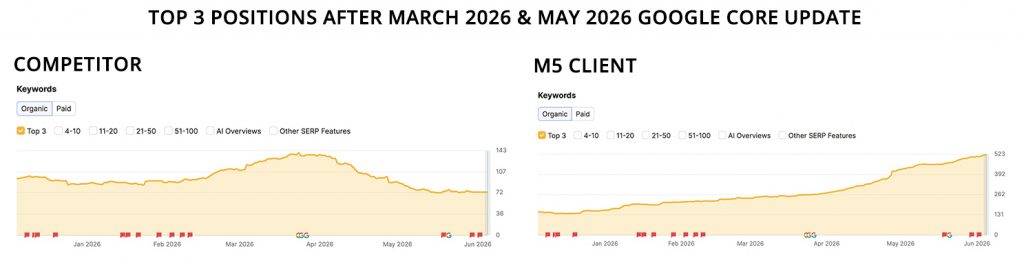
Top-3 keyword rankings, December 2025 to June 2026. Competitor (left): peaked at 143, dropped to approximately 72 following the March and May 2026 core updates. M5 client (right): grew from 131 to 523 through both core updates without interruption. SEMrush data.
AI Overview appearances collapsed from a peak of 214 to approximately 54, a loss of approximately 75 percent of their AI visibility in two months.
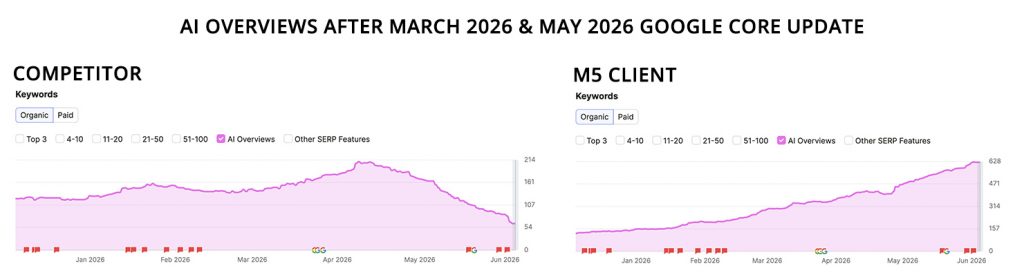
AI Overview keyword appearances, December 2025 to June 2026. Competitor (left): peaked at 214, dropped to approximately 54 following the March and May 2026 core updates. M5 client (right): grew from 157 to 628 through both core updates without interruption. SEMrush data.
The same Google algorithm markers visible on both charts correlate directly with the timing of the March and May 2026 core updates.
Google’s spam policies explicitly name scaled content abuse as a target, described as generating many pages without adding value for users. Google’s optimization guide updated May 15, 2026 reinforces the same standard. The competitor’s publishing cadence and the timing of their decline are consistent with the pattern those policies target. We cannot confirm from the data alone that scaled AI content was the exclusive cause. What the data does confirm is that the timing correlates, the scale was there, and the result was a significant loss of visibility across both organic rankings and AI Overviews.
Now look at what happened to an M5 client in the same vertical over the same period.
Top-3 keyword rankings grew from approximately 131 in December 2025 to approximately 523 by June 2026. AI Overview appearances grew from approximately 157 to approximately 628 over the same period. Both the March and May 2026 core update markers are visible on the M5 client charts. Neither caused a decline. The growth curve actually steepened after the March update, the same update that cut the competitor’s visibility in half.
The difference is obvious: Consistent white hat SEO. The M5 client has been building visibility the right way for years. Content grounded in genuine expertise. No shortcuts, no scaled content strategies designed to game rankings in the short term.
Here is something you might not know. AI Overview visibility is not immune to core update recalibration. As you can see in the charts above, you can gain it fast with scaled content and lose it just as fast. The competitor’s AI Overview chart is proof of that. So, do you want to build consistent growth with genuine expertise or take shortcuts and watch it crash after a quick growth?
Google’s updates are not random. They are directional. And the direction has been consistent across every update in 2026: original expertise wins, scaled volume loses.
This is exactly the kind of account M5 monitors in real time. If your traffic chart looks similar and you want to understand what the data is telling you specifically, that conversation starts with a free strategy call.
What the Data Shows in One Legal Sector
Let’s take a look to five sites in the same legal industry vertical tracked via SEMrush, a consistent pattern emerged that is worth sharing as a directional observation. These are not five similar sites. They range from an Authority Score of 28 with approximately 4,300 monthly organic visits to an Authority Score of 55 with approximately 875,900 monthly organic visits. Different sizes, different authority levels, different traffic scales.
The pattern is the same across all five.
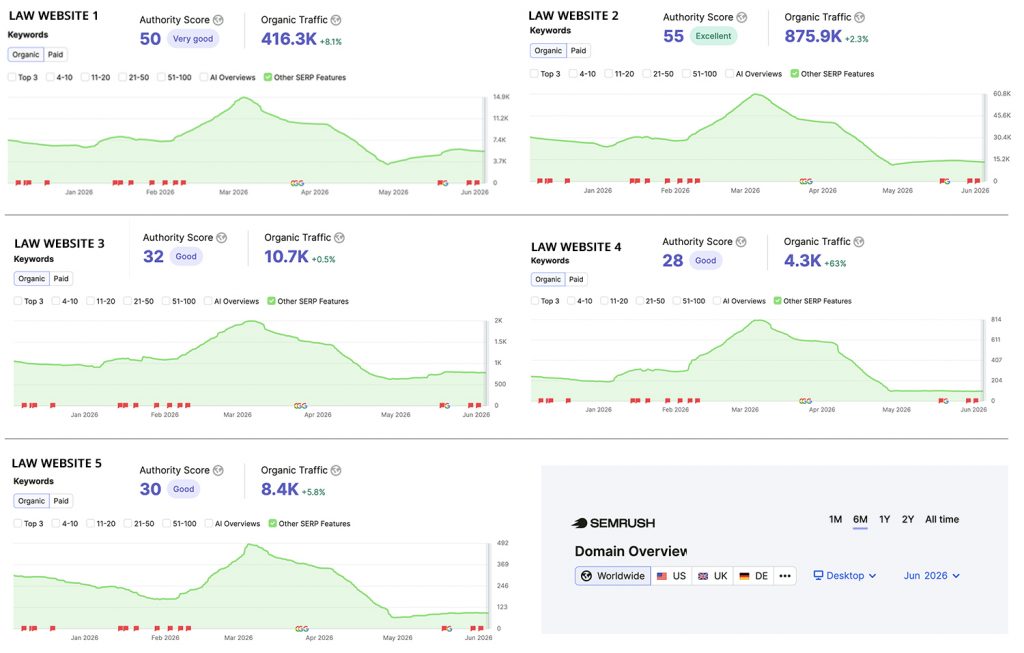
Other SERP feature appearances, which include featured snippets, People Also Ask boxes, knowledge panels, and similar search features, peaked across all five sites around March 2026 before declining sharply following the March core update. The May 2026 update produced a noticeably smaller additional impact on these same SERP features. Several sites showed early signs of stabilization or modest recovery by June 2026.
What makes this observation meaningful is not that five sites declined. It is that five sites at completely different scales declined in the same pattern at the same time. The graph looks like a photocopy, right? Authority score did not protect them. Traffic volume did not protect them. The March 2026 core update affected SERP feature visibility across this vertical regardless of site size.
What these graphs tell us within this legal vertical:
- The March 2026 core update was the more significant event for SERP feature visibility.
- May 2026 core update continued the same directional shift but at lower intensity.
- If your SERP feature visibility dropped sharply in March and has not recovered, the primary recalibration appears to have happened then.
- The May 2026 update compounded it. That distinction matters for how you prioritize your recovery work.
Please note: this is a directional observation from five sites in a single legal vertical tracked via SEMrush. It is not a confirmed industry-wide finding.
The One-Week Wait: When to Actually Start Your Assessment
You should wait one week before analyzing the data from this core update, the date starts from June 2, not May 21. If you have been counting from the launch date, reset your timeline now.
This matters more than it might seem. Rankings can continue settling in the days immediately following a rollout completion, even after Google posts the official confirmation. Per Google’s own core update documentation, the recommendation is to wait at least a full week after the update completes before analyzing your site in Search Console, then compare that week against a week before the update started.
That means the right date to begin your full assessment is approximately June 9. That is when you compare your post-update data against your pre-May 21 baseline and draw conclusions about what actually moved and why.
Most business owners who read our original article have been counting from May 21. That is understandable. The update launched on May 21 and the anxiety started on May 21. But the data you would have been analyzing during the rollout was mid-flux, unreliable, and in some cases showing the two-wave pattern we covered above. Decisions made on that data would have been decisions made on noise.
June 9 is the date. Mark it. That is when to open Search Console, run the comparison, and decide whether what you are seeing warrants action.
What to Do Right Now: Your June 2 Checklist
Four actions worth taking between now and your June 9 assessment window.
1. Check your backlink profile somewhere other than Search Console.
The GSC Links report broke on May 21, and as of June 3, it is still showing placeholder data for some sites. So if Search Console suddenly shows zero backlinks, or a massive overnight drop, do not treat that as reality.
Use a third-party tool like SEMrush to verify what actually changed.
And more importantly, do not make link strategy decisions based on the GSC Links report right now. The data is not reliable enough for that.
2. Document your current baseline.
Open Search Console and GA4 today. Record your current clicks in Search Console and your organic sessions in GA4. Those are the numbers you will compare against once the rollout is finished and the data has had time to settle, for now, use clicks as your cleaner signal.
Impressions can still help, but do not rely too heavily on older impression comparisons. Google’s impression logging issue affected data before April 27, 2026, so those older trends may not give you a reliable baseline.
Clicks are not perfect either, but right now they are the safer number to use when documenting where things stand.
3. Do not make content decisions yet. Wait for the June 9 comparison window before touching anything that was performing well before May 21.
4. Run the full assessment on June 9. Compare your post-update week against your pre-May 21 week. The full data assessment framework is in our original core update article.
May 2026 Core Update FAQs
Is the May 2026 Google Core Update Officially Finished?
Yes. Google confirmed the May 2026 core update completed on June 2, 2026, twelve days after it began on May 21. The official confirmation is on the Google Search Status Dashboard.
Why Did My Rankings Drop Twice During the Rollout?
SEMrush Sensor data recorded multiple High volatility spikes across the twelve-day rollout, with peaks around May 19, May 30, and June 1 to 2, separated by brief periods of relative calm. Rankings moved, appeared to stabilize, then moved again. If that is what your dashboard looked like over the past two weeks, you were not alone. It is one update, not two separate problems.
When Should I Start Analyzing My Rankings?
The one-week wait starts from June 2, the completion date, not May 21. Begin your full Search Console assessment around June 9, comparing that week against a week before May 21. Per Google’s official core update documentation, waiting at least a full week after completion gives you the cleanest possible baseline.
Was the May 2026 Update Worse Than March 2026?
Both were among the most volatile core updates in recent years. The March 2026 update saw 79.5 percent of top-three URLs change position and 90.7 percent of top-ten results shift, per SE Ranking analysis. May recorded similarly high volatility scores across tracking tools. Whether May was worse than March will become clearer when the full post-completion data is analyzed. M5 will cover that comparison in the follow-up analysis publishing soon.
What Does the Early Data Show About Winners and Losers?
Early data from tracking tools and patterns M5 is observing across accounts suggest content-heavy sites, particularly those relying on high-volume informational queries, saw significant visibility declines during both the March and May 2026 update periods. The legal industry example earlier in this article illustrates what that pattern looks like in practice, including losses across both organic rankings and AI Overview appearances.
Sites with genuine expertise, original content, and clean SEO foundations appear to have held or recovered more consistently. Whether Google calls these outcomes recalibrations or not, the practical consequence for affected businesses is the same: fewer rankings, less traffic, and in some cases reduced AI Overview visibility, with no explanation from Google about what changed or why.
This is directional and the full picture is still being compiled. M5 will publish the complete breakdown in the follow-up analysis coming soon.
What Is the GSC Links Report Bug and Has It Been Fixed?
The Google Search Console Links report broke on May 21, 2026, the same day the core update launched, showing zero or dramatically reduced backlink counts for many sites across the industry. John Mueller acknowledged the issue and Google’s team temporarily reverted the report to data from the previous week as a placeholder while engineers worked on the underlying problem.
As of June 3, 2026, the bug has not been fully resolved. The Links report is currently displaying older placeholder data, not your current live backlink profile. There is no confirmed timeline from Google for when accurate live data will be restored.
Do not make any link strategy decisions based on what Search Console is showing right now. Use Ahrefs or SEMrush to verify your actual backlink profile until Google confirms the fix is complete.
This is another example of Google’s opacity in practice. The update launched, the reporting tool broke on the same day, and businesses are left making decisions with incomplete data while waiting for a fix that has no public timeline. Check the Google Search Central Data Anomalies page for the most current status before making any link-related decisions.
Should I Make Changes to My Content Now That the Update Is Complete?
Not yet. Wait until your June 9 assessment window before making content decisions based on post-update data. Use the time between now and then to document your baseline in Search Console and GA4. The full assessment framework is in our original core update article.
Will There Be Another Google Core Update Soon?
Google does not announce upcoming updates in advance. What the 2026 cadence tells us is that updates are coming more frequently and with higher volatility than in previous years. The March and May updates arrived roughly six weeks apart. Consistent, white hat SEO is the only reliable preparation for whatever comes next. Sites built on genuine expertise and clean SEO practice are better positioned to weather each recalibration than those chasing short-term ranking gains.
Conclusion
The May 2026 core update is behind us. Twelve days, multiple High volatility spikes per SEMrush Sensor, and rankings that moved more than once before settling.
What the data is showing directionally is the same thing it showed in March: Google is enforcing its content quality standard more aggressively with each update. Original expertise wins. Generic volume loses. That is not a new message. It is just being delivered with more force each time.
Google still has not told us exactly which sites were affected, why certain pages moved, or what separates a winner from a loser. That opacity is real. And businesses are the ones left dealing with it, not Google.
After 15 years of watching these updates, the pattern is hard to ignore. The sites that recover are usually the ones with the strongest foundation: clean, consistent SEO, packed with useful content and real expertise. Plus, good technical health and no tricks pretending to be a strategy.
The next important date is June 9. That is when the data should be clean enough to start the real assessment. M5 will be back before then with a full post-update analysis covering what the final numbers show across industries, what changed, and what to prioritize next.
Not Sure What Your Data Is Telling You?
If your rankings shifted and you want a second set of eyes on your Search Console data before your June 9 assessment, that is exactly what our free strategy call is for.
Book Your Free SEO Consultation
References
- Google Search Status Dashboard, May 2026 Core Update Completion Notice status.search.google.com
- Google Search Central, “Core Updates Documentation” developers.google.com/search/docs/appearance/core-updates
- Google Search Central, “Data Anomalies in Search Console” support.google.com/webmasters/answer/6211453
- Search Engine Roundtable, “Google Search Console Fixes 50 Week Data Logging Issue” Barry Schwartz seroundtable.com/google-search-console-fix-data-logging-issue-41260.html
- Google Search Central, “Debug Google Search Traffic Drops” developers.google.com/search/docs/monitor-debug/debugging-search-traffic-drops
- SEMrush Sensor, “SERP Volatility Score, United States, Desktop, All Categories, Last 30 Days” Accessed June 3, 2026 semrush.com/sensor/